Guide
Japanese Traditional Tattoo in Ho Chi Minh City: A Guide to Irezumi, Artists and Long-Term Projects
A guide to Japanese traditional tattooing in Ho Chi Minh City, from Irezumi composition and artist selection to sleeves, backpieces and long-term tattoo projects.
Japanese Traditional Tattoo in Ho Chi Minh City
Japanese traditional tattooing has become an increasingly visible part of the tattoo culture in Ho Chi Minh City. For clients looking for more than a small standalone tattoo, Irezumi offers a different approach: the artwork is planned as a composition that develops with the body, rather than as a collection of unrelated images.
At Saigon Needle, we focus on Japanese traditional tattooing, large-scale compositions, sleeves, backpieces and long-term projects in District 3, Ho Chi Minh City.
What Is Japanese Traditional Tattooing?
Japanese traditional tattooing, often referred to as Irezumi, is built around strong composition, movement, symbolism and the relationship between the artwork and the body.
Traditional Japanese imagery includes dragons, koi, tigers, samurai, warriors, mythical creatures, flowers, wind, waves and other elements drawn from Japanese art, folklore and mythology.
The important part is not simply choosing a Japanese tattoo image.
A successful large-scale Japanese tattoo considers how the subject, background and body placement work together. The composition should follow the natural movement of the body and remain visually connected as the project develops.
Japanese Tattoo Composition and Body Flow
One of the defining characteristics of large Japanese tattoo projects is body flow.
A sleeve, backpiece or larger composition should be designed around the anatomy rather than placed on the body like an isolated illustration.
The artist considers the shape of the shoulder, arm, chest, back, hip or leg, then builds the composition around those areas.
Background elements such as wind, water, clouds and waves can connect different parts of the tattoo and create continuity throughout the project.
This is particularly important when planning a long-term Irezumi project.
Sleeves, Backpieces and Long-Term Projects
Many Japanese traditional tattoos are developed over multiple sessions.
A sleeve may begin with a main figure or motif and gradually develop into a larger composition. A backpiece may require careful planning around the shoulders, spine, lower back and surrounding areas.
For clients planning a larger Japanese tattoo in Ho Chi Minh City, it is useful to think about the project as a complete composition from the beginning.
The first consultation can help determine:
• the main subject• the body placement• the approximate size• the background• the relationship between different sections• the expected number of sessions• the overall direction of the project
Planning early can prevent individual pieces from competing with each other later.
Choosing a Japanese Tattoo Artist in Ho Chi Minh City
Choosing an artist should be based on more than whether you like a single tattoo photograph.
Look at the artist's portfolio as a whole.
Pay attention to composition, consistency, line quality, shading, background treatment and how the work follows the body.
For a large Japanese tattoo, the artist's ability to design the entire project can be just as important as the execution of an individual motif.
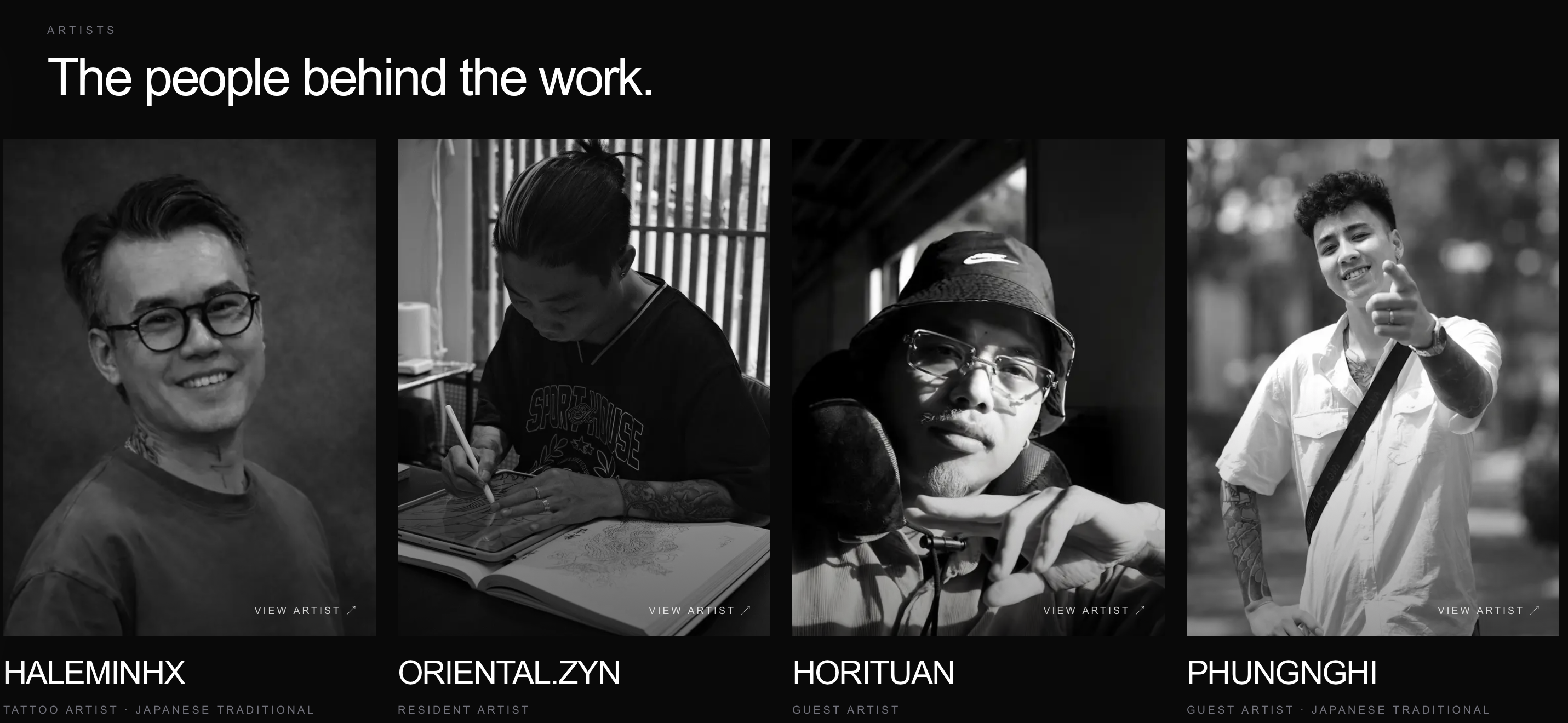
At Saigon Needle, HALEMINHX focuses on traditional Japanese tattooing and large-scale compositions, with projects developed around body movement and long-term collaboration with collectors.
The studio also works with guest and resident artists whose portfolios cover different approaches to Japanese traditional tattooing.
Explore the Saigon Needle artist pages before deciding which direction best fits your project.
Popular Japanese Traditional Tattoo Subjects
Japanese tattooing includes a wide range of subjects, each with its own visual language and cultural background.
Dragons are commonly used in large compositions because their long, flowing forms work naturally around the body.
Koi can be developed with water, waves and other background elements to create strong movement across an arm, leg or larger composition.
Kintaro, samurai and other legendary figures can form the central subject of sleeves, backpieces and full-body projects.
Kitsune, Hannya and other figures from Japanese folklore can also be developed into highly detailed compositions.
The most important consideration is not simply the popularity of the subject, but how the subject can be composed for the individual body.
Japanese Tattoo Projects in Ho Chi Minh City
Saigon Needle's project archive documents completed and ongoing Japanese tattoo projects, including full backs, sleeves, full legs, bodysuits and collaborative projects.
Examples include the AKUGENTA YOSHIHIRA full-back collaboration, MONGAKU Japanese bodysuit, SAMURAI BACKPIECE, KITSUNE BACKPIECE, Kintaro projects and Japanese dragon work.
These projects show how Japanese tattooing can be approached as a long-term visual composition rather than a single isolated tattoo.
For clients researching Japanese tattoo ideas in Vietnam, studying completed projects can also help clarify the difference between choosing an image and planning an entire tattoo.
Getting a Japanese Traditional Tattoo in Ho Chi Minh City
For international visitors and clients travelling to Vietnam specifically for a tattoo, planning ahead is especially important.
A consultation can be used to discuss your preferred subject, placement, approximate size, references and available dates.
You can bring reference images if you have them, but you do not need to arrive with every detail decided.
The artist can help determine how the idea should be adapted to your body and how it can develop into a cohesive composition.
At Saigon Needle, the studio is located at 390/14 Nguyen Dinh Chieu, District 3, Ho Chi Minh City, Vietnam.
For clients travelling from another city or country, contacting the studio in advance is recommended so that the project and available appointment dates can be discussed before travelling.
Why Long-Term Planning Matters
Large Japanese tattoos can take multiple sessions and may develop over weeks, months or longer periods.
This makes the relationship between artist and client an important part of the process.
The goal is not simply to finish a tattoo quickly.
The goal is to build a composition that continues to work as more of the body is completed.
A carefully planned Japanese tattoo should remain visually balanced from different angles and distances, while the individual elements continue to make sense within the larger composition.
Start Your Japanese Tattoo Project in Ho Chi Minh City
If you are considering a Japanese traditional tattoo in Ho Chi Minh City, the first step is consultation.
Tell us what you are interested in, where you would like the tattoo, the approximate size and your preferred dates.
You can also explore our Japanese tattoo projects and artist portfolios before contacting the studio.
Whether you are planning a sleeve, backpiece, full leg, bodysuit or another long-term Irezumi project, the process begins with understanding the body, the subject and the direction of the complete composition.
Saigon Needle390/14 Nguyen Dinh ChieuDistrict 3, Ho Chi Minh City, Vietnam
Book a consultation to discuss your Japanese traditional tattoo project.
Japanese traditional tattooing has become an increasingly visible part of the tattoo culture in Ho Chi Minh City. For clients looking for more than a small standalone tattoo, Irezumi offers a different approach: the artwork is planned as a composition that develops with the body, rather than as a collection of unrelated images.
At Saigon Needle, we focus on Japanese traditional tattooing, large-scale compositions, sleeves, backpieces and long-term projects in District 3, Ho Chi Minh City.
What Is Japanese Traditional Tattooing?
Japanese traditional tattooing, often referred to as Irezumi, is built around strong composition, movement, symbolism and the relationship between the artwork and the body.
Traditional Japanese imagery includes dragons, koi, tigers, samurai, warriors, mythical creatures, flowers, wind, waves and other elements drawn from Japanese art, folklore and mythology.
The important part is not simply choosing a Japanese tattoo image.
A successful large-scale Japanese tattoo considers how the subject, background and body placement work together. The composition should follow the natural movement of the body and remain visually connected as the project develops.
Japanese Tattoo Composition and Body Flow
One of the defining characteristics of large Japanese tattoo projects is body flow.
A sleeve, backpiece or larger composition should be designed around the anatomy rather than placed on the body like an isolated illustration.
The artist considers the shape of the shoulder, arm, chest, back, hip or leg, then builds the composition around those areas.
Background elements such as wind, water, clouds and waves can connect different parts of the tattoo and create continuity throughout the project.
This is particularly important when planning a long-term Irezumi project.
Sleeves, Backpieces and Long-Term Projects
Many Japanese traditional tattoos are developed over multiple sessions.
A sleeve may begin with a main figure or motif and gradually develop into a larger composition. A backpiece may require careful planning around the shoulders, spine, lower back and surrounding areas.
For clients planning a larger Japanese tattoo in Ho Chi Minh City, it is useful to think about the project as a complete composition from the beginning.
The first consultation can help determine:
• the main subject• the body placement• the approximate size• the background• the relationship between different sections• the expected number of sessions• the overall direction of the project
Planning early can prevent individual pieces from competing with each other later.
Choosing a Japanese Tattoo Artist in Ho Chi Minh City
Choosing an artist should be based on more than whether you like a single tattoo photograph.
Look at the artist's portfolio as a whole.
Pay attention to composition, consistency, line quality, shading, background treatment and how the work follows the body.
For a large Japanese tattoo, the artist's ability to design the entire project can be just as important as the execution of an individual motif.
At Saigon Needle, HALEMINHX focuses on traditional Japanese tattooing and large-scale compositions, with projects developed around body movement and long-term collaboration with collectors.
The studio also works with guest and resident artists whose portfolios cover different approaches to Japanese traditional tattooing.
Explore the Saigon Needle artist pages before deciding which direction best fits your project.
Popular Japanese Traditional Tattoo Subjects
Japanese tattooing includes a wide range of subjects, each with its own visual language and cultural background.
Dragons are commonly used in large compositions because their long, flowing forms work naturally around the body.
Koi can be developed with water, waves and other background elements to create strong movement across an arm, leg or larger composition.
Kintaro, samurai and other legendary figures can form the central subject of sleeves, backpieces and full-body projects.
Kitsune, Hannya and other figures from Japanese folklore can also be developed into highly detailed compositions.
The most important consideration is not simply the popularity of the subject, but how the subject can be composed for the individual body.
Japanese Tattoo Projects in Ho Chi Minh City
Saigon Needle's project archive documents completed and ongoing Japanese tattoo projects, including full backs, sleeves, full legs, bodysuits and collaborative projects.
Examples include the AKUGENTA YOSHIHIRA full-back collaboration, MONGAKU Japanese bodysuit, SAMURAI BACKPIECE, KITSUNE BACKPIECE, Kintaro projects and Japanese dragon work.
These projects show how Japanese tattooing can be approached as a long-term visual composition rather than a single isolated tattoo.
For clients researching Japanese tattoo ideas in Vietnam, studying completed projects can also help clarify the difference between choosing an image and planning an entire tattoo.
Getting a Japanese Traditional Tattoo in Ho Chi Minh City
For international visitors and clients travelling to Vietnam specifically for a tattoo, planning ahead is especially important.
A consultation can be used to discuss your preferred subject, placement, approximate size, references and available dates.
You can bring reference images if you have them, but you do not need to arrive with every detail decided.
The artist can help determine how the idea should be adapted to your body and how it can develop into a cohesive composition.
At Saigon Needle, the studio is located at 390/14 Nguyen Dinh Chieu, District 3, Ho Chi Minh City, Vietnam.
For clients travelling from another city or country, contacting the studio in advance is recommended so that the project and available appointment dates can be discussed before travelling.
Why Long-Term Planning Matters
Large Japanese tattoos can take multiple sessions and may develop over weeks, months or longer periods.
This makes the relationship between artist and client an important part of the process.
The goal is not simply to finish a tattoo quickly.
The goal is to build a composition that continues to work as more of the body is completed.
A carefully planned Japanese tattoo should remain visually balanced from different angles and distances, while the individual elements continue to make sense within the larger composition.
Start Your Japanese Tattoo Project in Ho Chi Minh City
If you are considering a Japanese traditional tattoo in Ho Chi Minh City, the first step is consultation.
Tell us what you are interested in, where you would like the tattoo, the approximate size and your preferred dates.
You can also explore our Japanese tattoo projects and artist portfolios before contacting the studio.
Whether you are planning a sleeve, backpiece, full leg, bodysuit or another long-term Irezumi project, the process begins with understanding the body, the subject and the direction of the complete composition.
Saigon Needle390/14 Nguyen Dinh ChieuDistrict 3, Ho Chi Minh City, Vietnam
Book a consultation to discuss your Japanese traditional tattoo project.