Motif
The Dragon in Japanese Tattooing
The Japanese dragon is more than a powerful tattoo subject. Its movement, symbolism and relationship with water and clouds make it a natural foundation for large-scale body compositions.
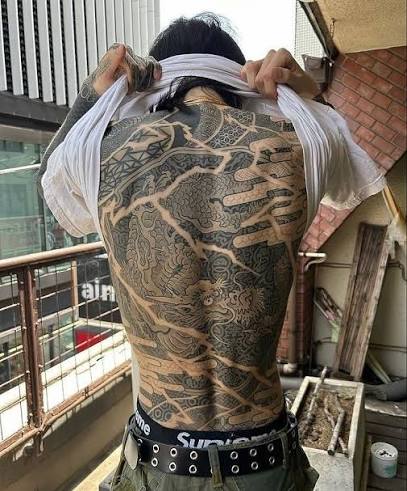
The Japanese dragon is one of the most recognizable subjects in traditional Japanese tattooing.
But its importance goes beyond its appearance.
Unlike the Western image of a dragon as a winged creature associated with fire, the Japanese dragon is closely connected with water, clouds, rain and the natural world.
This relationship gives the dragon a distinctive sense of movement.
The body of the dragon can travel around the curves of the body, while clouds, wind and water create a background that supports the direction of the composition. This makes the subject especially suitable for large-scale Japanese tattoo projects.
The dragon is also a highly adaptable subject.
Its body can be arranged vertically along an arm, wrapped around a leg, extended across the back or developed as part of a larger bodysuit composition.
For a tattoo artist, this flexibility creates many possibilities, but it also requires careful planning.
The head, body, claws and tail need to work together with the anatomy of the client. The background should support the movement rather than compete with the main figure.
At Saigon Needle, we are interested in the dragon not simply as an individual image, but as part of a larger composition.
A successful dragon tattoo should feel as though the figure belongs to the body. Its movement should follow the anatomy, while the surrounding background gives the composition depth and continuity.
Traditional Japanese tattooing also places importance on the relationship between subject and background. The dragon does not exist alone. Water, clouds, wind and other elements help establish its environment and visual rhythm.
This is particularly important when developing a large project over multiple sessions.
The first session is only one part of the final composition. Every later decision needs to respect what has already been established while leaving enough room for the project to develop.
For this reason, choosing a dragon is often the beginning of a much larger conversation about composition, placement and long-term direction.
The final tattoo is not only about the dragon itself.
It is about how the dragon moves with the body.
As a Japanese Traditional tattoo studio in Ho Chi Minh City, Vietnam, Saigon Needle approaches dragon tattoos as part of a broader body composition. The subject, background and anatomy are considered together from the beginning of the project.
But its importance goes beyond its appearance.
Unlike the Western image of a dragon as a winged creature associated with fire, the Japanese dragon is closely connected with water, clouds, rain and the natural world.
This relationship gives the dragon a distinctive sense of movement.
The body of the dragon can travel around the curves of the body, while clouds, wind and water create a background that supports the direction of the composition. This makes the subject especially suitable for large-scale Japanese tattoo projects.
The dragon is also a highly adaptable subject.
Its body can be arranged vertically along an arm, wrapped around a leg, extended across the back or developed as part of a larger bodysuit composition.
For a tattoo artist, this flexibility creates many possibilities, but it also requires careful planning.
The head, body, claws and tail need to work together with the anatomy of the client. The background should support the movement rather than compete with the main figure.
At Saigon Needle, we are interested in the dragon not simply as an individual image, but as part of a larger composition.
A successful dragon tattoo should feel as though the figure belongs to the body. Its movement should follow the anatomy, while the surrounding background gives the composition depth and continuity.
Traditional Japanese tattooing also places importance on the relationship between subject and background. The dragon does not exist alone. Water, clouds, wind and other elements help establish its environment and visual rhythm.
This is particularly important when developing a large project over multiple sessions.
The first session is only one part of the final composition. Every later decision needs to respect what has already been established while leaving enough room for the project to develop.
For this reason, choosing a dragon is often the beginning of a much larger conversation about composition, placement and long-term direction.
The final tattoo is not only about the dragon itself.
It is about how the dragon moves with the body.
As a Japanese Traditional tattoo studio in Ho Chi Minh City, Vietnam, Saigon Needle approaches dragon tattoos as part of a broader body composition. The subject, background and anatomy are considered together from the beginning of the project.